Combination
Definition
Let be a finite set with elements, and let . A combination is a selection of elements from in which order is not taken into account.
Interpretation
A combination records only which objects are chosen, not in which order: choosing then gives the same combination as choosing then . A -combination of a set is therefore simply a subset with elements: rearranging the chosen objects gives no new outcome.
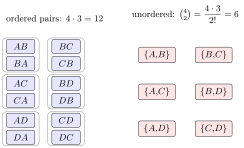
The figure counts pairs from the four letters in two steps. First the order is kept: ordered pairs. Then the boxes put each pair together with its reversal, such as with , and each box becomes one unordered pair. Every unordered pair appears exactly times among the ordered ones, so there are of them.
The same argument works in general. There are ordered selections of distinct objects (-permutations), and each group of objects can be ordered in ways, so the number of combinations is the binomial coefficient .
To decide which count applies, ask whether swapping two chosen objects changes the result: for a committee it does not, for a president and a secretary it does. Combinations here use each object at most once; when repetition is allowed, unordered selections are counted with stars and bars. In naive probability, numerator and denominator must be counted the same way, both ordered or both unordered; mixing the two gives a wrong ratio.
Key Results
- Combinations ignore order, while permutations count order.
- The number of -combinations from distinct objects is .
- Combinations are used in sampling without regard to sequence.
Examples
- Choosing three committee members from twelve people is a combination problem.
- A five-card poker hand is counted as a combination because the order of the cards in the hand does not matter.
- Selecting two spare parts from a box of ten distinct parts is counted by .
Prerequisites
Related Concepts
Sources
- Probability Theory for EOR · Week 1
Aliases: k-combination, unordered selection, k-subset, combination without repetition, unordered sample without replacement
Last updated: 20 October 2026 03:02
CombinationBinomial CoefficientHypergeometric DistributionSampling With and Without ReplacementSetk-PermutationStars and BarsCountingFactorial