Outcome
Definition
Let be a sample space. An outcome is an element representing one possible result of the random experiment.
Interpretation
An outcome is one complete result of the experiment, described at the level of detail that the model records. Each run of the experiment produces exactly one outcome.
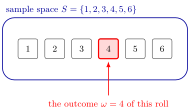
The figure shows the sample space of a die roll with the realized outcome . The event occurs because it contains ; the event does not.
How much detail an outcome carries is a modelling choice: for two coin tosses an outcome can be the ordered pair, such as , or only the number of heads. For fair coins the four ordered pairs are equally likely, while the three counts are not, since one head arises from both and .
An outcome is an element of , while an event is a set of outcomes. Later, a random variable attaches a number to each outcome.
Key Results
- An outcome is a single element of the sample space.
- The level of detail in an outcome depends on how the experiment is modelled.
- Events are collections of outcomes.
Examples
- For one die roll, the outcome can be the face that appears.
- For two coin tosses, an outcome can record the ordered pair of heads and tails.
- For a customer-order experiment, an outcome might include purchase amount, item type, and delivery time.
Prerequisites
Related Concepts
Sources
- Probability Theory for EOR · Week 1
Aliases: sample point, elementary outcome Symbols: element of, omega
Last updated: 20 October 2026 03:02
OutcomeSample SpaceSetEventRandom Variable