Prosecutor's Fallacy
Description
The prosecutor's fallacy is the error of confusing the probability of observing evidence under a hypothesis with the probability that the hypothesis is true given the evidence.
Interpretation
The prosecutor's fallacy swaps the two sides of a conditional probability. It reads , which says how surprising the evidence would be if the suspect were innocent, as , which is the quantity a court needs. This can make evidence sound much stronger than it is.
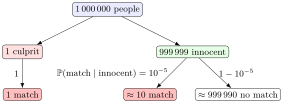
In a population of people there is one culprit, who matches, and innocent people, each matching with probability , so about of them match by chance. Among the roughly people who match, only one is the culprit. Thus , although .
A tiny chance of an innocent match, spread over a large population, still produces several innocent matches. Compare with .
Bayes' rule shows what the fallacy leaves out. Writing for "innocent" and for "match", it gives . The tiny is divided by , which by the law of total probability is itself only about , because nearly all matches come from innocent people. The answer therefore depends on how many other people could have produced the evidence. If other information had narrowed the suspects down to people, about innocent matches would be expected and would be below .
The same reasoning applies to a positive test for a rare disease: a test that rarely errs can still produce mostly false positives when the disease itself is rare.
Key Results
- The fallacy confuses with .
- Bayes' rule shows that posterior probabilities require prior probabilities and alternative explanations.
- Rare evidence is not automatically decisive if it can also occur under competing hypotheses.
Examples
- A rare DNA match probability is not the same as the probability that a defendant is innocent.
- A rare disease test result is not the same as the probability of disease without considering prevalence.
- A suspicious transaction pattern must be compared against both fraud and non-fraud explanations.
Prerequisites
Related Concepts
Sources
- Probability Theory for EOR · Week 2
Aliases: prosecutor's fallacy, confusion of the inverse, prosecutor fallacy, fallacy of the transposed conditional, inverse fallacy
Last updated: 20 October 2026 03:02
Prosecutor's FallacyBayes RuleConditional ProbabilityLaw of Total Probability