Generated Event
Definition
Let be a random variable and let be a Borel set: a set built from open intervals using complements and countable unions, such as any interval or finite set. The event generated by and is
Interpretation
A generated event turns a statement about the value of a random variable into an event in the original sample space: " lies in " becomes the set of outcomes with .
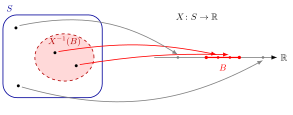
In the figure the two outcomes inside the shaded oval are sent into the interval , and the two outcomes outside it are sent to points outside . The shaded set, labelled , is the generated event: exactly the outcomes whose arrows end in . The notation does not require to have an inverse function; it only names the set of outcomes sent into .
The usual shorthand drops the outcome: , and are sets of outcomes, and is the probability of such a set. Different sets can generate the same event: for a die roll , the sets and both generate "an even number is rolled", because no outcome is sent to . Operations on sets of values carry over to events, for example and , so the rules for complements and intersections of events apply directly.
Generated events connect a random variable to its distribution, which is defined by the probabilities , and to its CDF, built from the events . Math III later studies the same construction for general functions under the name preimage.
Key Results
- Generated events are preimages of numerical sets under a random variable.
- Statements such as are events in the original sample space.
- The distribution of a random variable is defined through probabilities of generated events.
Examples
- If is a die roll, the event generated by and the set of even numbers is rolling an even value.
- If is waiting time, the statement 'wait at most five minutes' is a generated event.
- If is a test score, the event 'score at least seventy' is generated by an interval of scores.
Prerequisites
Related Concepts
Sources
- Probability Theory for EOR · Week 3
Keywords: event generated by a random variable, preimage event Symbols: element of, intersection, omega, real numbers, subset
Last updated: 20 October 2026 03:02
Generated EventRandom VariableEventCumulative Distribution FunctionSupport of a Random VariableImage and Preimage of a Set