Geometric Distribution
Definition
Let and . A discrete random variable has a geometric distribution with parameter , written , if counts the failures before the first success in independent trials with success probability :
At the first trial is a success, so with probability .
Interpretation
The geometric distribution counts how many failures happen before the first success in independent trials with success probability . A value of zero means that the first trial succeeds.
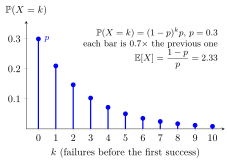
In the figure : the bar at is , and each next bar is times the previous one, so the bars decrease like the terms of a geometric series, which gives the distribution its name. The most likely value is , while the mean given in the figure lies further to the right because of the long tail.
Each bar is times the one before, starting at . A smaller means a longer wait: .
Each trial is a Bernoulli variable, and means failures followed by a success, with probability by independence. The masses sum to because . The tail formula in the Key Results, , has an equally direct reading: at least failures occur exactly when the first trials all fail. It also shows that waiting does not help: given failures so far, the conditional probability of at least more is , the memoryless property.
Books and software use the name "geometric" for two versions. This page counts failures, with values ; the first success distribution counts trials including the success, , with values . Before using a formula, check which values it starts from.
Key Results
- and .
- For integers , .
Examples
- For , .
- For , the expected failure count is .
Prerequisites
Related Concepts
Sources
- Probability Theory for EOR · Week 3
- Probability Theory for EOR · Week 4
- Nicky van Foreest · Probability Distributions · Refresher
Aliases: Geom(p), geometric random variable, zero-based geometric distribution, Geo(p) Keywords: failures before first success Symbols: sum
Last updated: 20 October 2026 03:02
Geometric DistributionBernoulli DistributionIndependent Random VariablesProbability Mass FunctionFirst Success DistributionMemoryless PropertyNegative Binomial DistributionGeometric Series