Counting
Definition
Let be a finite set. Counting is the process of determining the number of elements of , usually by using systematic rules such as addition, multiplication, permutations, or combinations.
Interpretation
Counting methods help determine how many outcomes are possible. They are essential when probabilities are based on equally likely outcomes.
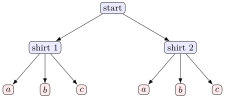
The diagram pairs each of two shirts with each of three pairs of trousers, giving outfits. Multiplying the numbers of choices counts these ordered combinations; whether order matters determines when permutations or combinations are appropriate.
Finite and infinite sets distinguishes a finite outcome count from an unbounded or countably infinite collection. Cardinality is the number being computed; the counting rules provide ways to find it without listing every element.
Key Results
- The counting multiplication rule multiplies the number of choices at successive stages: if every first-stage choice has second-stage choices and there are first-stage choices, there are ordered outcomes.
- The addition rule counts alternatives that do not overlap: for disjoint finite sets, . Overlapping alternatives need the inclusion–exclusion principle.
- Counting arguments support naive probability models when outcomes are equally likely.
Examples
- A password with two letters followed by three digits has possibilities when all 26 letters and 10 digits are allowed at each position and repetition is permitted.
- If a menu offers either a soup or a salad but not both, the addition rule counts the first-course choices.
- Counting favourable poker hands and total poker hands gives a naive probability.
Prerequisites
Related Concepts
Sources
- Probability Theory for EOR · Week 1
Keywords: combinatorics, enumerative combinatorics Symbols: union
Last updated: 20 October 2026 03:02
CountingMultiplication Rule for CountingNaive ProbabilitySampling With and Without ReplacementStars and BarsFinite and Infinite SetsCardinalitySetk-PermutationCombinationBinomial CoefficientFactorialBirthday ProblemDiscrete Random Variable