Minimum of Independent Exponentials
Theorem
Let be independent exponential random variables with rates . Then is exponentially distributed with rate .
Interpretation
The minimum is the time at which the first of several independent clocks rings. Each running clock is another chance for an early ring, so the rates add up.
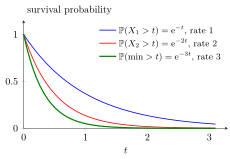
The blue and red curves are the survival probabilities and of two independent clocks with rates and . The green curve is their product , the survival probability of the minimum. It lies below both, because the minimum survives past only if both clocks do: its mean is , against and .
Multiply the survival curves: the minimum survives only if both clocks do, which gives rate . The simulation agrees with the exponential density.
For the proof is one line:
The first step uses that the minimum exceeds if and only if every does, and independence to factor the probability. Without independence it can fail: if , the minimum is just with rate . The second step uses the exponential form, since a product of exponential tails is again an exponential tail. For other distributions the type usually changes: for two independent variables, on , which is not the tail of a uniform distribution.
Which clock rings first is also simple: clock wins with probability , which is for the rate- clock in the figure. In two independent Poisson processes, the wait until the next arrival in either one is such a minimum, so the combined arrivals come at rate .
Key Results
- The minimum of independent exponentials is exponential with rate equal to the sum of the rates.
- The probability that a particular clock is first is its rate divided by the total rate.
- This result connects competing risks with Poisson process arrivals.
Examples
- If two repair teams respond independently, the first response time can be modelled as the minimum of two exponential times.
- In competing failure modes, the first failure time has rate equal to the sum of mode-specific rates.
- If buses from two routes arrive independently, the next bus time can be the minimum of the two route waiting times.
Prerequisites
Related Concepts
Sources
- Probability Theory for EOR · Week 6
Aliases: minimum of exponentials Keywords: exponential race, competing exponential clocks Symbols: lambda
Last updated: 22 October 2026 19:04
Minimum of Independent ExponentialsExponential DistributionIndependent Random VariablesMinimum of a SetPoisson ProcessOrder StatisticDensity of an Order Statistic