Conditional Independence
Definition
Let , , and be events with . The events and are conditionally independent given if
Interpretation
Conditional independence means two events stop influencing each other once certain information is known. It is a statement about independence inside a restricted situation.
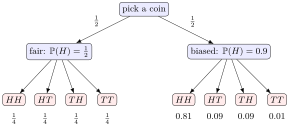
The diagram chooses a fair coin or a coin with head probability , each with probability , and tosses the chosen coin twice. Given its identity , the two heads events are independent. Without this conditioning, , whereas .
Conditional probability first restricts the model to . The factorization for independent events is then applied inside that restricted model; ordinary independence before conditioning does not automatically imply it.
Key Results
- Conditional independence is not the same as ordinary independence.
- Two variables can be dependent marginally but conditionally independent after a common cause is known.
- Conditional independence is central in graphical and hierarchical probability models.
Examples
- Two symptoms may be dependent overall but conditionally independent given the disease status.
- Two students' answers may become conditionally independent once their preparation levels are known.
- Machine failures in different locations may be conditionally independent given the weather condition.
Prerequisites
Related Concepts
Sources
- Probability Theory for EOR · Week 2
Keywords: conditionally independent events Symbols: intersection
Last updated: 16 October 2026 22:28
Conditional IndependenceConditional ProbabilityIndependent EventsBayes Rule