Mode
Definition
Let be a random variable. A mode of is a value at which the probability mass function or probability density function attains its maximum.
Interpretation
A mode is the most likely value of a discrete distribution, or the value where a density is highest, that is, where values are most concentrated. On a graph it is the location of the highest peak.
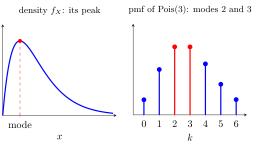
In the left panel the density peaks at , where is zero. For this density the median is about and the mean is , so the three centres differ. In the right panel the PMF has two equally high bars, , so both and are modes.
For the lognormal density, change and watch mode, median and mean drift apart. For the Poisson distribution, set to a whole number to get two modes.
For a density, finding the mode is a maximization problem from calculus: look for a stationary point or an endpoint of the support. A mode of a continuous distribution has probability like every value; it is where short intervals of a fixed length carry the most probability. For the Poisson distribution with a whole-number rate , the ratio equals at , which explains the two modes and .
A mode need not be unique or lie near the middle. Every face of a fair die is a mode, and the exponential density has its mode at , the smallest possible value. A density with several local peaks is called multimodal, even when only the highest peak is a mode in the strict sense.
Key Results
- A mode is a maximizer of the mass function or density function.
- A distribution may have more than one mode.
- For continuous distributions, density height is not itself probability.
Examples
- A fair die has every face as a mode because all faces are equally likely.
- A normal distribution has one mode at its centre.
- A mixture of two separated normal distributions can be bimodal, with two peaks; both peaks are modes in the strict sense only when they have equal height.
Prerequisites
Related Concepts
Sources
- Probability Theory for EOR · Week 6
Aliases: modal value Keywords: mode of a distribution Symbols: lambda, sigma
Last updated: 20 October 2026 03:02
ModeUnimodal and Multimodal DistributionProbability Mass FunctionProbability Density FunctionSummary Measures of a Distribution