Partition of a Set
Definition
A partition of a set is a family of nonempty subsets satisfying
In probability, take , the sample space, and require the blocks to be events. The elementary total-probability sums use finite or countable partitions. A nonempty event can still have probability zero; omit such blocks from formulas that divide by their probability.
Interpretation
A partition splits a set into nonempty blocks that do not overlap and together cover everything, so every element lands in exactly one block. In probability, a partition of the sample space is a complete list of cases without overlaps: every outcome belongs to exactly one case.
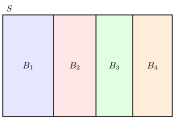
The four strips satisfy for and , so additivity gives . Any event is cut by the strips into the pieces , which are again disjoint with union , so : a question is split into cases.
Both conditions are needed for this sum. If two blocks overlapped, outcomes in the overlap would be counted twice; if the blocks did not cover the whole sample space, outcomes outside all blocks would be missed and the sum would be too small. The simplest partition is for one event with its complement; others are the six values of a die or the possible numbers of defective items in a batch.
Writing turns the sum into the law of total probability, which in turn supplies the denominator of Bayes' rule. In Math II, the equivalence classes of an equivalence relation form a partition of the set, and every partition arises in this way.
Key Results
- Every outcome belongs to exactly one partition event.
- For any event , the events are disjoint and have union .
Examples
- For a fair die, the odd and even outcomes partition .
- For an integer-valued count , the events partition the outcomes if takes finite nonnegative integer values.
Prerequisites
Related Concepts
Sources
- Probability Theory for EOR · Week 2
- Nicky van Foreest · Probability Distributions · Week 3
Aliases: set partition Keywords: partition of the sample space, case split, Partition Symbols: element of, intersection, sum, union
Last updated: 20 October 2026 03:02
Partition of a SetLaw of Total ProbabilityLaw of Total Expectation over a PartitionDisjoint EventsUnion and Intersection of EventsBayes RuleEquivalence RelationEvent