Equivalence Relation
Definition
An equivalence relation on a set is a relation on such that, for all , it is:
- reflexive: ;
- symmetric: if , then ;
- transitive: if and , then .
Interpretation
An equivalence relation formalizes when different objects should be treated as the same for a particular purpose, for example integers that leave the same remainder after division by , or sets of the same cardinality.
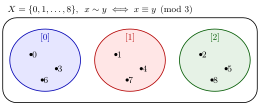
In the figure if and only if and leave the same remainder after division by , on the set , labelled in the figure. The relation sorts the nine numbers into the three equivalence classes , and , where . The classes partition : every element lies in exactly one class, and if and only if .
Each property has a job. Reflexivity puts into its own class , so no element is left out. Symmetry and transitivity prevent classes from overlapping without being equal: if lies in both and , then and , so and the two classes coincide. Without one of them this breaks down. The relation on is reflexive and transitive but not symmetric, and "differ by at most " is reflexive and symmetric but not transitive: is related to and to , but is not related to .
Equal cardinality is another example: it relates two sets when there is a bijection between them.
Key Results
- Equal cardinality is an equivalence relation on sets.
Examples
- Congruence modulo is an equivalence relation on integers.
Prerequisites
Related Concepts
Sources
- Math II: Linear Algebra · Week 1
Aliases: equivalency relation Keywords: equivalence class Symbols: element of, real numbers
Last updated: 20 October 2026 03:02
Equivalence RelationSetCardinalityPartition of a Set