Definite Matrix
Definition
Let be a real symmetric matrix. The definiteness of classifies the sign of the quadratic form :
- Positive definite: for every nonzero vector .
- Positive semidefinite: for every vector .
- Negative definite: for every nonzero vector .
- Negative semidefinite: for every vector .
- Indefinite: takes both positive and negative values.
Interpretation
Definiteness tells whether the quadratic form determined by a symmetric matrix is always positive, always nonnegative, always negative, always nonpositive, or changes sign. It is the matrix version of the sign of in .
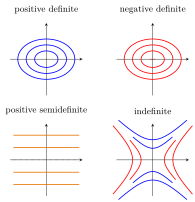
The four panels show the curves on which is constant, its level curves, for , , and . For a diagonal matrix the form is , so its signs can be read off the diagonal. The first two give ellipses, the first form positive and the second negative in every direction. The third form, , gives horizontal lines and is zero along the whole -axis: nonnegative but not positive, so positive semidefinite. The fourth, , gives hyperbolas and takes both signs.
Positive definite means for every : the curve on the right stays above . Try the examples, and look for directions where the form vanishes.
A positive definite gives a bowl, a negative definite one a cap, and an indefinite one a saddle; the eigenvalues are shown below.
The definition quantifies over all nonzero , not only the axes. Testing the standard basis vectors gives , so a positive definite matrix has positive diagonal entries. The converse fails: has a positive diagonal, but the value at , so it is indefinite. The categories overlap: every positive definite matrix is also positive semidefinite, and the zero matrix is both positive and negative semidefinite.
In one variable, the second-order condition reads the sign of at a stationary point. For functions of several variables, a symmetric matrix of second derivatives takes the place of , and its definiteness separates local minima, maxima and saddle points.
Key Results
- A symmetric matrix is positive definite if and only if all its eigenvalues are positive.
- A symmetric matrix is positive semidefinite if and only if all its eigenvalues are nonnegative.
- A symmetric matrix is negative definite if and only if all its eigenvalues are negative.
- A symmetric matrix is negative semidefinite if and only if all its eigenvalues are nonpositive.
- A symmetric matrix is indefinite if and only if it has both positive and negative eigenvalues.
Examples
- is positive definite, while is negative definite.
- is positive semidefinite, and is indefinite.
Prerequisites
Related Concepts
Sources
- Math II: Linear Algebra · Week 6
Aliases: nonnegative definite Keywords: positive definite matrix, positive semidefinite matrix, negative definite matrix, negative semidefinite matrix, indefinite matrix, definiteness
Last updated: 20 October 2026 03:02
Definite MatrixDefiniteness and EigenvaluesHessian Test for Convexity and ConcavityPrincipal Minors and Sylvester's CriterionQuadratic Form on a Constraint SetUnconstrained Extrema ConditionsSingular ValueQuadratic FormSymmetric MatrixVariance and Standard DeviationEigenvalue and Eigenvector