Continuum Hypothesis
Definition
The continuum hypothesis is the hypothesis that there is no set whose cardinality is strictly between and .
Interpretation
Aleph null, , is the size of the natural numbers; the cardinality of the continuum, , is the size of the reals. These are the two endpoints between which the hypothesis rules out an intermediate cardinality.
It asks whether there is an intermediate size of infinity between the natural numbers and the real numbers.
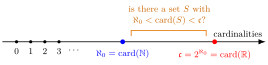
Equivalently, the continuum hypothesis states , where is the smallest cardinality larger than (see aleph null). Assuming the standard axioms of Zermelo–Fraenkel set theory with the axiom of choice (ZFC) are consistent, they can neither prove nor refute this hypothesis (Gödel, 1940; Cohen, 1963).
Key Results
- In symbols, it denies the existence of a set such that .
- A bijection is the main tool for proving that two sets have the same cardinality.
Examples
- The question compares the size of with the size of .
Prerequisites
Related Concepts
Sources
- Math II: Linear Algebra · Week 1
Aliases: CH, Cantor's continuum hypothesis Symbols: natural numbers, real numbers
Last updated: 20 October 2026 03:02
Continuum HypothesisAleph NullCardinality of the ContinuumPower SetCountable and Uncountable SetsCantor's TheoremCantor's Diagonal Argument