Cantor's Theorem
Theorem
Cantor's theorem states that for every set ,
where is the power set of .
Interpretation
Cantor's theorem says that a set always has more subsets than elements: no function from to its power set , also written , can reach every subset. This holds for infinite sets too.
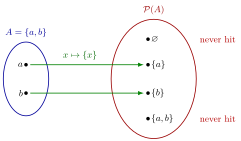
For the power set has elements. The map is injective, which shows , but it hits only and , never or . For a finite set with elements the theorem is just ; its content is that no other map does better, even for infinite sets.
The reason is a diagonal construction. Given any , form . If for some , then exactly when , which is impossible. So is missed and no is surjective, in particular no is a bijection. In the figure every lies in , so , one of the two missed subsets.
Applied to , the theorem gives the uncountable set , whose cardinality is the cardinality of the continuum. Applied again and again it gives , so there is no largest infinite size. The argument has the same shape as Cantor's diagonal argument for the real numbers.
Key Results
- For every infinite set , the sets represent an infinite staircase of larger and larger infinite cardinalities.
- A bijection is the main tool for proving that two sets have the same cardinality.
Examples
- For , the power set has larger cardinality than .
Prerequisites
Related Concepts
Sources
- Math II: Linear Algebra · Week 1
Aliases: Cantor theorem, Cantor's power set theorem Symbols: element of, natural numbers
Last updated: 27 October 2026 11:52
Cantor's TheoremPower SetCardinalityCantor's Diagonal ArgumentFunctionCardinality of the ContinuumAleph NullContinuum Hypothesis