Dimension
Definition
The dimension of a finite-dimensional vector space is the length of any basis of that vector space. It is denoted by .
Interpretation
Dimension counts how many independent directions are needed to describe every vector in the space: it is the number of vectors in a basis, and so the number of coordinates each vector gets. The definition makes sense because in a finite-dimensional vector space all bases have the same length.
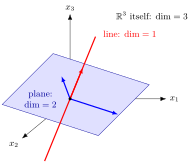
The figure shows the three cases inside . One nonzero arrow spans a line through the origin, of dimension . Two arrows that do not lie on one line span a plane through the origin, of dimension . Three independent arrows are needed for all of , of dimension . The line and the plane are subspaces of with their own dimension, not the dimension of the surrounding space.
Dimension can be read in two equivalent ways: it is the largest number of linearly independent vectors in , and the smallest number of vectors in a spanning list of . So in any three vectors are linearly dependent, and no single vector spans . In the same way, a subspace never has a larger dimension than the space that contains it.
Dimension is not the number of vectors in the space: the line in the figure contains infinitely many vectors but has dimension . The zero space is the only space of dimension .
Key Results
- Any two bases of a finite-dimensional vector space have the same length.
- Every basis of contains exactly vectors.
Examples
- has dimension .
- The vector space of polynomials of degree at most has dimension , with basis .
Prerequisites
Related Concepts
Sources
- Math II: Linear Algebra · Week 2
- Math V: Advanced Linear Algebra · Week 5 (revisited)
Aliases: Hamel dimension, vector space dimension Keywords: dimension of a vector space Symbols: real numbers
Last updated: 20 October 2026 03:02
DimensionFundamental Theorem of Linear MapsGeneral Solution of a Linear ODEBasisFinite-Dimensional Vector SpaceRankCardinalityDirect SumLinear Dependence and IndependenceSpanning List