Permutation
Definition
A permutation of a set is a bijective function
Interpretation
A permutation rearranges the elements of a set without losing or duplicating any element: each element is moved to a place in the same set, and each place receives exactly one element.
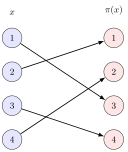
The arrows send , , and , and every number on the right is hit by exactly one arrow, which is bijectivity. In two-row notation, lists the images in the bottom row. Following the arrows from gives the cycle , written . Reversing every arrow gives the inverse , which undoes .
Bijectivity has two halves. Injective means that no two elements land in the same place, so nothing is duplicated; surjective means that every place is filled, so nothing is lost. On a finite set either half implies the other, since elements land in places. On an infinite set they differ, as the map on in the Examples shows.
To count the permutations of an -element set, choose the image of the first element in ways, that of the second in ways, and so on, which gives (factorial). This is the same count as for ordered arrangements of distinct objects. Under composition the permutations of form the symmetric group .
Key Results
- The composition of two permutations is again a permutation.
- A finite set with elements has permutations.
Examples
- Swapping two elements and leaving the rest fixed is a permutation.
- On , the map , , is a permutation. The map on is injective but not surjective, so it is not a permutation of .
Prerequisites
Related Concepts
Sources
- Math II: Linear Algebra · Week 1
Keywords: rearrangement, bijection of a set onto itself Symbols: natural numbers, pi
Last updated: 20 October 2026 03:02
PermutationSymmetric GroupBijection and Inverse FunctionPermutation MatrixFactorialCombinationDeterminant