Let F be a field, and let V and W be vector spaces over F. A linear mapA:V→W is a function satisfying additivity A(u+v)=Au+Av and homogeneity A(λu)=λAu for all u,v∈V and λ∈F. The set of all linear maps from V to W is denoted L(V,W).
Two canonical examples are the zero map0:V→W, defined by 0(v)=0W, and the identity mapI:V→V, defined by I(v)=v. If A,B∈L(V,W) and λ∈F, then the sum and scalar multiple of linear maps are defined by
(A+B)(v)(λA)(v)=Av+Bv,=λ(Av).
These operations make L(V,W) itself a vector space.
A linear map preserves the linear structure of a vector space: it respects vector addition and scalar multiplication. It does not matter whether vectors are first combined and then mapped, or first mapped and then combined: A(λu+μv)=λAu+μAv.
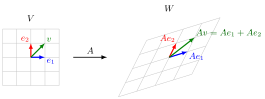
The square grid of V, with e1,e2 and v=e1+e2, is mapped to a slanted grid. By additivity, Av=Ae1+Ae2: the diagonal of the unit square goes to the diagonal of the parallelogram formed by Ae1 and Ae2. The grid lines stay straight, parallel and evenly spaced, and 0 stays at 0. A linear map is determined by its images of a basis; here Ae1 and Ae2 are the matrix columns.
Drag the images Ae1 and Ae2 of the basis vectors: they decide where the whole grid goes, and Ax=x1Ae1+x2Ae2. Move t to slide from the identity to A.
Every linear map sends 0 to 0, because A0=A(0⋅0)=0⋅A0=0. This gives a quick test: g(x,y,z)=x−y+2z+1 from the Examples fails it. Fixing the origin is not enough, though: x↦x2 on R sends 0 to 0, but (1+1)2=4=12+12, so additivity fails.
The two conditions are differentiation rules already known from Math I: (f+g)′=f′+g′ and (cf)′=cf′, which is why differentiation is a linear map. A common slip comes from the everyday name "linear function" for f(x)=ax+b: it is a linear map only when b=0; for b=0 its graph is a line that misses the origin.
A linear map is completely determined by what it does to a basis of its domain.
The setL(V,W) of all linear maps from V to W is itself a vector space.
A function f:Rn→Rk is linear if and only if f(x)=Ax for some k×nmatrixA, and then A is unique: its j-th column is f(ej). In particular a linear map sends 0 to 0, so a function x↦Ax+b with b=0 is not linear but affine.
Linear map and linear transformation are synonyms. A linear map from a space to itself is also called a linear operator.
Aliases: linear transformation, linear mapping, vector space homomorphism
Keywords: zero map, identity map, sum of linear maps, scalar multiple of a linear map, standard matrix, matrix of a linear map
Symbols: element of, lambda, mu, real numbers
Last updated: 20 October 2026 03:02
Linear MapProduct of Linear MapsKernelLinear OperatorRange of a Linear MapAffine MapJacobian MatrixTotal Derivative as a Linear MapMatrix Representation of a Linear MapVector SpaceFieldFunctionMatrix