Matrix Diagonals
Definition
For an matrix :
- the main diagonal consists of the entries with ;
- the anti-diagonal of a square matrix () consists of the entries ;
- the off-diagonal entries are all entries with .
Interpretation
The main diagonal runs from the top-left entry downwards to the right, through the entries whose row and column index agree. The anti-diagonal of a square matrix runs from bottom-left to top-right; the off-diagonal entries are all the others.
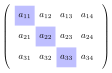
In the matrix shown, the main diagonal (shaded) is . It stops after entries, so a non-square matrix has a main diagonal too, but it does not end in the bottom-right corner.
Diagonal matrices have zeros everywhere off the main diagonal and triangular matrices on one side of it. The transpose mirrors a matrix in it, so the diagonal entries stay in place.
Key Results
- Diagonal entries are central in definitions of diagonal matrices, triangular matrices, and the trace.
- A square matrix is diagonal exactly when all off-diagonal entries are zero.
Examples
- In , the main diagonal is and the anti-diagonal is .
- In , all off-diagonal entries are zero.
Prerequisites
Related Concepts
Sources
- Math II: Linear Algebra · Week 4
Aliases: matrix diagonal, leading diagonal Keywords: principal diagonal, main diagonal, anti-diagonal, antidiagonal, off-diagonal, diagonal entries
Last updated: 20 October 2026 03:02
Matrix DiagonalsDiagonal MatrixTraceTriangular MatrixMatrixBlock MatrixIdentity Matrix