Euclidean Norm
Definition
For a vector , the Euclidean norm (also called the length or 2-norm) is
A unit vector is a vector with norm . For nonzero , the vector is the unit vector in the direction of ; this process is called normalization.
Interpretation
The Euclidean norm measures the length of a vector, the distance from the origin to its tip. It extends the absolute value of a number: for , . Normalization keeps the direction of a nonzero vector but changes its length to .
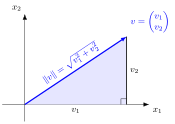
In the figure the components and are the legs of a right triangle and is its hypotenuse, so Pythagoras gives ; for instance . In Pythagoras applied twice gives , and the definition continues the pattern to coordinates.
Drag : its norm is the hypotenuse of the right triangle with legs and . Dividing by moves the vector onto the unit circle.
The squares make every term nonnegative, so , with equality only for ; the square root brings the result back to the scale of the coordinates. Writing the norm as ties length to the inner product, which also gives angles and orthogonality. Scaling by scales the length by , so is as long as .
The norm of a difference is the Euclidean distance , and lengths satisfy the triangle inequality. The modulus of a complex number is the same length for the point . Math III later treats the Euclidean norm as one of several norms on .
The norm is not the sum of the entries: , not , and in the vector has norm . Also , while itself needs the square root.
Key Results
- , and if and only if .
- .
- If , then .
- The Euclidean norm is one example of a norm; other norms on , such as the maximum norm, measure length differently.
Examples
- If , then .
- The normalization of is .
Prerequisites
Related Concepts
Sources
- Math II: Linear Algebra · Week 5
- Math V: Advanced Linear Algebra · Week 5 (revisited)
Aliases: Euclidean length, 2-norm, length of a vector, L2 norm Keywords: norm, unit vector, normalization, normalized vector, normalised vector Symbols: alpha, element of, real numbers, square root
Last updated: 20 October 2026 03:02
Euclidean NormAngle Between VectorsCauchy-Schwarz InequalityDistance Between a Point and a LineEuclidean DistanceTriangle Inequality for Vector NormsDirectional DerivativeEquivalent NormsMaximum NormNorm and Normed Vector Spacep-norm and p-metricTaxicab MetricSteepest Ascent DirectionGram-Schmidt AlgorithmLeast SquaresOrthogonal ProjectionOrthonormal BasisSingular ValueVectorAbsolute ValueInner ProductComplex Absolute ValueOrthogonal Vectors