Imaginary Unit
Definition
The imaginary unit, symbolized as , is characterized by its square being , i.e.,
Interpretation
Integer powers mean repeated multiplication, so implies and . Higher powers therefore repeat in a cycle of length four.
The imaginary unit is a solution, not the solution, to the equation since is also a solution.
The choice of over as the "principal" square root of is largely a matter of convention, similar to how we choose the positive square root of a positive number as its principal square root.
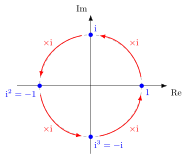
: multiplying by is a rotation by , so four multiplications return to the start ().
Drag : multiplying by turns it a quarter turn, and doing it twice gives .
Key Results
- Complex numbers extend the real numbers by adding a solution of .
- The complex numbers form a field, so they can be used as scalars in complex vector spaces.
Examples
- The roots of are .
- For , the real part is , the imaginary part is , and .
Prerequisites
Related Concepts
Sources
- Math II: Linear Algebra · Week 1
Aliases: unit imaginary number Symbols: square root
Last updated: 20 October 2026 03:02
Imaginary UnitComplex NumberExponentiation and PowerComplex MultiplicationCartesian Representation of Complex Numbers