Complex Conjugate
Definition
Given a complex number where , the conjugate of the complex number is defined as
Interpretation
Conjugation keeps the real part of and changes the sign of its imaginary part. Geometrically, it reflects in the real axis.
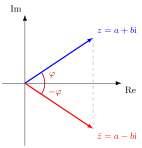
The point lies straight below , at the same distance from the real axis. A reflection keeps lengths, so for the modulus, and reverses angles, so the argument becomes .
Drag : is its mirror image in the real axis, with the angle .
Conjugation is useful because it produces real numbers: and . The second identity is behind division: multiplying numerator and denominator by makes the denominator the real number . Also is real if and only if , and conjugating twice gives back. Because conjugation respects sums and products (Key Results), it sends a root of a polynomial with real coefficients to another root: the complex conjugate root theorem.
Key Results
- We have and
- and are symmetric about the real axis.
Examples
- .
- .
Prerequisites
Related Concepts
Sources
- Math II: Linear Algebra · Week 1
Aliases: complex conjugation, conjugate of a complex number Symbols: element of, phi, real numbers
Last updated: 20 October 2026 03:02
Complex ConjugateComplex Conjugate Root TheoremComplex ReciprocalComplex Conjugate Pair of EigenvaluesComplex NumberComplex Absolute ValueComplex DivisionFundamental Theorem of AlgebraNegation