Cauchy-Schwarz Inequality
Theorem
For vectors and in an inner product space, the Cauchy-Schwarz inequality states ; in with the dot product this reads .
Interpretation
The inner product of two vectors can never exceed the product of their lengths in absolute value. Equivalently, for nonzero vectors the quotient always lies between and .
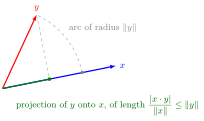
The figure drops a perpendicular from the tip of onto the line of the nonzero vector . The green segment from the origin to its foot has length , and as a side of a right triangle with hypotenuse it ends inside the arc of radius . Multiplying by gives the inequality; equality holds when already lies on the line of , so that the segment reaches the arc.
Drag and : never exceeds , because the shadow of on the line of is never longer than . Equality holds exactly when the vectors lie on one line.
The inequality holds for all vectors, including , where both sides are . Equality holds if and only if one vector is a multiple of the other, that is, when both lie on one line through the origin. The absolute value matters: is very negative for long ; only the size of the inner product is bounded.
The inequality is what makes the angle between vectors well defined in , since a cosine must lie in , and it is the key step in proving the triangle inequality . Its proof uses only the defining properties of an inner product, so it holds for every inner product with . It returns later in a version for random variables.
Key Results
- Cauchy-Schwarz justifies the formula for the angle between vectors.
- It can be used to prove the triangle inequality.
Examples
- For orthogonal vectors, the left side is .
- For , equality holds.
Prerequisites
Related Concepts
Sources
- Math II: Linear Algebra · Week 5
Aliases: Cauchy-Bunyakovsky-Schwarz inequality, Schwarz inequality, Cauchy's inequality, CBS inequality, Cauchy-Schwarz Symbols: real numbers, square root
Last updated: 20 October 2026 03:02
Cauchy-Schwarz InequalityTriangle Inequality for Vector NormsInner ProductEuclidean NormAngle Between VectorsOrthogonal VectorsCauchy–Schwarz Inequality for Random Variables