Linear Dependence and Independence
Definition
A collection of vectors is linearly dependent if there exist scalars , not all zero, such that
The collection is linearly independent if this can only happen when
Interpretation
Linear dependence means that at least one vector is redundant because it can be written using the others. Linear independence means that no vector in the collection is redundant: the only combination that gives is the one with all coefficients zero.
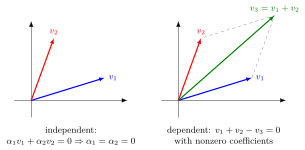
In the left panel, and point in different directions, so can only return to when . In the right panel, is the diagonal of the parallelogram, so is a combination with nonzero coefficients , and , and the three vectors are dependent.
Drag onto the line through (or press the button): then a combination with coefficients not all zero gives , and the collection is dependent.
The two readings agree. If with some , then dividing by , which is possible because the scalars come from a field, writes as a combination of the others. Conversely, writing as a combination of the others gives such a relation with coefficient at . Dependence does not mean that every vector is redundant: in , the vector is not a combination of the others, yet the list is dependent because .
Independence is what makes representations unique: if , then , so for every . This is why a basis must be independent. Two vectors are dependent if and only if one is a scalar multiple of the other, and three vectors in are dependent if and only if they lie in one plane through the origin.
Key Results
- A collection is linearly independent if and only if every vector in its span has a unique expression as a linear combination of the collection.
- Any collection containing the zero vector, a repeated vector, or a scalar multiple of another vector is linearly dependent.
Examples
- In , and are linearly independent.
- In , and are linearly dependent, since .
Prerequisites
Related Concepts
Sources
- Math II: Linear Algebra · Week 2
- Math V: Advanced Linear Algebra · Week 5 (revisited)
Keywords: linearly independent, linearly dependent, linear dependence, linear independence, independent vectors, dependent vectors Symbols: alpha, beta, real numbers, sum
Last updated: 20 October 2026 03:02
Linear Dependence and IndependenceBasisDistinct Eigenvalues TheoremEigenbasisPlaneBasis of Solutions of a Difference EquationGeneral Solution of a Linear ODEGram-Schmidt AlgorithmVectorLinear CombinationZero VectorSpanning ListDimensionRankAlgebraic and Geometric MultiplicityDirect Sum