Symmetric Matrix
Definition
A symmetric matrix is a real square matrix satisfying . Equivalently, its entries satisfy for all .
Interpretation
The transpose exchanges entry with . Equality with the transpose therefore requires matching entries on the two sides of the diagonal, not merely matching diagonal entries.
A symmetric matrix is unchanged by reflection across its main diagonal.
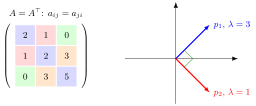
The eigenvectors of the symmetric matrix are orthogonal. In general a real symmetric matrix has real eigenvalues and an orthonormal eigenbasis: where is the diagonal matrix of eigenvalues and is orthogonal, , with mutually orthogonal unit eigenvectors as columns (spectral theorem).
With the eigenvector lines are perpendicular. Switch the symmetry off and change : the right angle is lost.
Key Results
- Every real diagonal matrix is symmetric.
- If and are symmetric, then is symmetric, but need not be symmetric.
Examples
- is symmetric.
- is not symmetric.
Prerequisites
Related Concepts
Sources
- Math II: Linear Algebra · Week 3
Aliases: self-adjoint matrix Symbols: lambda
Last updated: 20 October 2026 03:02
Symmetric MatrixDefinite MatrixDefiniteness and EigenvaluesMoore-Penrose InverseSingular Value DecompositionSingular ValueMatrixTransposeQuadratic FormDiagonalizationEigenvalue and EigenvectorOrthonormal Basis