Cantor's Diagonal Argument
Theorem
Cantor's diagonal argument shows that there is no bijection between and the interval .
Interpretation
If a list claimed to contain every binary expansion in , one can construct a new sequence by flipping the diagonal entries. This new sequence differs from the th listed sequence in its th digit, so it cannot be on the list. Strictly, a few numbers have two binary expansions (), which is why each 0-1 sequence corresponds to a unique number, but not quite conversely. Every number has at most two expansions, so a list of all numbers in would still give a list of all 0-1 sequences, and the conclusion stands.
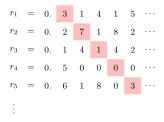
The decimal illustration highlights diagonal digits , which can be changed to , giving a new number with prefix . At every subsequent position, choose either or so that the chosen digit differs from the corresponding diagonal digit. The resulting expansion is neither eventually all nor eventually all , so it avoids the ambiguity of two decimal representations. It therefore represents a number different from every in the proposed list.
Key Results
- The interval is uncountable.
- The real numbers have strictly larger cardinality than the natural numbers.
Examples
- From a list , define by making its th digit different from the th digit of .
Prerequisites
Related Concepts
Sources
- Math II: Linear Algebra · Week 1
Aliases: diagonal argument, Cantor's diagonalization, Cantor diagonalization, diagonalization argument, Cantor's diagonal method Symbols: natural numbers
Last updated: 20 October 2026 03:02
Cantor's Diagonal ArgumentCountable and Uncountable SetsBijection and Inverse FunctionCantor's TheoremAleph NullCardinality of the ContinuumContinuum Hypothesis