Fundamental Theorem of Algebra
Theorem
The fundamental theorem of algebra states that every nonconstant polynomial with complex number coefficients has at least one root in .
Interpretation
The theorem says that is large enough to solve all nonconstant single-variable polynomial equations over . In , by contrast, has no solution.
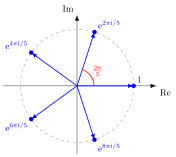
The figure shows the roots of , that is, the solutions of . By De Moivre's formula a solution must have modulus , since , and an angle for which is a multiple of . This gives five points on the unit circle, apart. Only is real: over the polynomial has one root, over it has five, as many as its degree.
Change the coefficients, even to complex ones: a polynomial of degree always has exactly roots in , counted with multiplicity.
The theorem guarantees only one root, but that is enough to find all of them. If is a root, polynomial long division by leaves remainder and a quotient of one degree lower, which again has a root if it is nonconstant. Repeating the step splits a polynomial of degree into linear factors, so it has exactly roots counted with multiplicity; has the single root , counted three times.
The word nonconstant is needed, since a nonzero constant polynomial has no root. The theorem says that roots exist, not how to compute them. For polynomials with real coefficients the non-real roots come in pairs by the complex conjugate root theorem, and in the language of fields the theorem says that is algebraically closed.
Key Results
- Every complex polynomial of degree has exactly roots when counted with multiplicity.
- Every complex polynomial of degree can be factored into linear factors over .
Examples
- has roots and in .
- has the root with multiplicity .
Prerequisites
Related Concepts
Sources
- Math II: Linear Algebra · Week 1
Aliases: FTA, d'Alembert-Gauss theorem, d'Alembert's theorem Symbols: complex numbers, lambda, phi, pi, real numbers
Last updated: 20 October 2026 03:02
Fundamental Theorem of AlgebraPolynomialComplex NumberRoot of a PolynomialAlgebraically Closed FieldPolynomial Long DivisionComplex Conjugate Root Theorem