Polar Representation of Complex Numbers
Definition
The polar coordinate system for complex numbers specifies each complex number by its modulus and polar angle (known as the argument). The form is called the polar form of a complex number.
Interpretation
The polar form describes a complex number by its distance from and the angle it makes with the positive real axis, instead of by its real and imaginary parts.
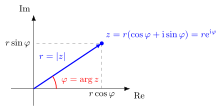
The arrow to has length and makes the angle with the real axis. The dashed lines meet the axes at and , by the trigonometric functions on a circle of radius . These are the real and imaginary parts of , which is why . The label also shows the short form given by Euler's formula.
Set the modulus and the angle , or drag : .
Going back uses and an angle with and . For this gives and , about . The angle has to be found from the signs of both and , not from alone: and have the same ratio but the angles and , and the 2-argument arctangent takes care of this.
The modulus of a nonzero point is unique, the angle is not: adding , , gives the same point, and the principal argument picks the value in . For one has and no angle is singled out. The polar form is made for multiplication: lengths multiply and angles add (complex multiplication), so powers follow from De Moivre's formula. For addition the Cartesian form is simpler.
Key Results
- Complex multiplication in polar form combines stretching (multiplying moduli) with rotation (adding arguments).
Examples
- The complex number has polar coordinates .
- The complex number has polar coordinates .
Prerequisites
Related Concepts
Sources
- Math II: Linear Algebra · Week 1
Aliases: Complex Plane (Polar Coordinate System), modulus-argument form Keywords: polar form, polar representation, trigonometric form Symbols: element of, integers, phi, pi, square root
Last updated: 20 October 2026 03:02
Polar Representation of Complex NumbersArgument of a Complex NumberComplex LogarithmDe Moivre's FormulaEuler's FormulaEuler's IdentityComplex NumberComplex Absolute ValuePolar Coordinate SystemCartesian Representation of Complex NumbersComplex Multiplication