Group
Definition
A group is a set together with a binary operation such that:
- is associative;
- has an identity element;
- every element has an inverse element.
Interpretation
Associativity allows parentheses to move in without changing the result. This makes repeated group operations unambiguous; it does not allow the factors to be reordered.
Groups capture the algebra of reversible operations.
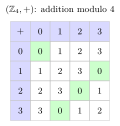
The table shows addition modulo , which is associative and has identity . Each row contains a green , exhibiting an additive inverse; for example, and . Each row and column is a permutation of . The symmetry of the table also shows that this group is Abelian.
Key Results
- Every group is a monoid.
- If the operation is also commutative, the group is Abelian.
Examples
- is a group. is not a group because positive natural numbers do not have additive inverses in .
Prerequisites
Related Concepts
Sources
- Math II: Linear Algebra · Week 1
Symbols: integers, natural numbers
Last updated: 20 October 2026 03:02
GroupAbelian GroupSymmetric GroupAssociativityIdentity ElementInverse ElementBinary OperationAlgebraic StructureCommutativityMonoidRingSemigroup