Rank
Definition
The rank of a matrix is the number of nonzero rows in its reduced row echelon form.
Full row, full column, and full rank
For an matrix :
- has full row rank if . This corresponds to the rows being linearly independent, so that has at least one solution for every right-hand side .
- has full column rank if . This corresponds to columns being linearly independent, so has at most one solution.
- A square matrix has full rank if ; this is equivalent to invertibility and to a nonzero determinant.
Interpretation
Rank measures how many independent pieces of information a matrix contains. It is the number of linearly independent columns, which equals the number of independent rows and the number of pivots left after row reduction.
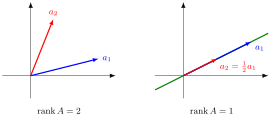
On the left, has independent columns spanning , so its rank is . On the right, has proportional columns, , spanning only a line, so its rank is and its determinant is zero.
Rank counts the dimensions of the current image of . Rank two gives the whole plane and kernel ; rank one gives a line image and line kernel; rank zero gives image and the whole plane as kernel. At this is the target .
Row operations do not change the solutions of , so they keep every linear relation between the columns. In the echelon form the pivot columns are independent and every other column is a combination of them, and the same holds for itself. So the number of pivots is the dimension of the range of , the span of the columns.
For a system with unknowns, the system is solvable if and only if the augmented matrix has the same rank as , and then the solutions have free variables. That number is the dimension of the kernel, by the fundamental theorem of linear maps.
A common slip is to count the nonzero rows of itself rather than of its echelon form: has two nonzero rows but rank , because the second row is twice the first.
Key Results
- The full row, full column, and full rank cases are special cases of rank.
- The rank equals the dimension of the range of the corresponding linear map.
- For an matrix, and .
Examples
- A zero matrix has rank .
- has rank .
Prerequisites
Related Concepts
- Dimension
- Linear Map
- Fundamental Theorem of Linear Maps
- Kernel
- Linear Dependence and Independence
- Row Echelon and Reduced Row Echelon Form
Sources
- Math II: Linear Algebra · Week 4
- Math V: Advanced Linear Algebra · Week 5 (revisited)
Aliases: matrix rank Keywords: full rank, full row rank, full column rank Symbols: element of, real numbers
Last updated: 27 October 2026 11:52
RankBordered Matrix TestIndependent Linear Constraint SystemJacobian Rank Local Behaviour TheoremLocal Injectivity, Surjectivity, and BijectivityNondegenerate Constraint QualificationGeneralized InverseRow SpaceMatrixRange of a Linear MapDimensionLinear MapFundamental Theorem of Linear MapsKernelLinear Dependence and IndependenceRow Echelon and Reduced Row Echelon Form