Complex Subtraction
Definition
Given two complex numbers and , the difference of complex numbers and is defined as
Interpretation
Subtracting means adding its negative: first take the complex negation , then use complex addition to add it to . Both steps work part by part, so the real parts and the imaginary parts are subtracted separately.
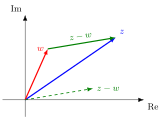
For and this gives . In the figure it is the green arrow from the tip of to the tip of , since ; the dashed arrow is the same arrow started at , so its tip is the point . Its length is the distance between the points and (see modulus).
, and the same arrow runs from to . Drag both points.
Subtraction is not commutative: is the arrow from back to , with the same length and the opposite direction. For example, , while . The same arrow picture returns later for the subtraction of vectors.
Key Results
- We have for any .
Examples
- .
Prerequisites
Related Concepts
Sources
- Math II: Linear Algebra · Week 1
Aliases: difference of complex numbers, subtraction of complex numbers Symbols: complex numbers, element of
Last updated: 20 October 2026 03:02
Complex SubtractionComplex NegationComplex AdditionComplex NumberCartesian Representation of Complex Numbers