Block Matrix
Definition
A block matrix is a matrix viewed as being partitioned into smaller matrices called blocks or submatrices.
A block diagonal matrix is a square block matrix of the form
where are square matrices.
Interpretation
Block notation treats a large matrix as a small matrix whose entries are themselves matrices. As long as the sizes fit, calculations can then be done with the blocks as if they were numbers, which keeps the structure of the matrix visible.
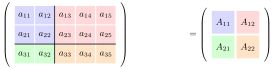
Cutting the matrix after row and after column gives four blocks: is , is , is and is . Blocks in the same block row have the same number of rows, and blocks in the same block column have the same number of columns.
When the column partition of matches the row partition of , block multiplication uses the same row-by-column rule as matrix multiplication; for example, the top-left block of is . The order of the factors must be kept, since the blocks are matrices and differs in general from .
Block diagonal matrices describe parts that do not interact. If is block diagonal with blocks and is split accordingly into , then consists of and , so the system splits into two smaller systems. Powers, and inverses when every block is invertible, are likewise computed block by block, and the determinant is the product of the blocks' determinants. A diagonal matrix is the special case with blocks.
Key Results
- Compatible block matrices can be added and multiplied block-by-block using the usual matrix rules.
- If is block diagonal with diagonal blocks , then
Examples
- is a matrix written in four blocks.
- is block diagonal.
Prerequisites
Related Concepts
Sources
- Math II: Linear Algebra · Week 5
- Math V: Advanced Linear Algebra · Week 6 (revisited)
Aliases: partitioned matrix, block matrices, submatrices, block diagonal matrices Keywords: submatrix, block diagonal matrix
Last updated: 20 October 2026 03:02
Block MatrixKronecker ProductMatrixDiagonal MatrixTraceMatrix AdditionMatrix ProductDeterminantMatrix Diagonals