Matrix
Definition
A matrix is a rectangular array of elements of a field, arranged in rows and columns. A matrix with rows and columns has size .
Two matrices are equal if and only if they have the same size and all corresponding entries are equal. A square matrix is a matrix with the same number of rows and columns.
Interpretation
Matrices store coefficients, describe linear maps in coordinates, and organize data in a way that supports algebraic operations. A matrix is a table of numbers in which the position of each entry carries meaning: its row and its column.
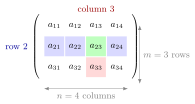
The figure shows a matrix: rows and columns, always counted in that order. The green entry lies where row crosses column ; the first index gives the row and the second the column, so would be a different position. The size is read " by ".
What rows and columns mean depends on the use. In a linear system in standard form, each row holds the coefficients of one equation and each column belongs to one unknown. For the map from to , column is the image of the th standard basis vector, so the number of columns is the number of input coordinates. In a data table, rows often correspond to observations and columns to variables.
A common slip is to treat a matrix as just a collection of numbers. The arrangement matters: and contain the same numbers but are different matrices, of sizes and . Special shapes are studied on their own pages, such as the identity matrix and symmetric matrices, which equal their transpose.
Key Results
- Rows are listed first and columns second: an matrix has rows and columns.
- A matrix can be viewed as a list of vertical or horizontal vectors; an matrix is a column vector and a matrix is a row vector.
- Matrices of different sizes cannot be equal; matrices of the same size are equal exactly when their corresponding entries match.
Examples
- is a square matrix.
- is a matrix and is not square.
Prerequisites
Related Concepts
Sources
- Math II: Linear Algebra · Week 3
Keywords: matrices, square matrix, rectangular matrix, order of a matrix, matrix equality, equal matrices Symbols: real numbers
Last updated: 20 October 2026 03:02
MatrixAugmented MatrixBlock MatrixCharacteristic PolynomialCofactor ExpansionDeterminantDiagonal MatrixDiagonalizable MatrixDiagonalizationElementary Row OperationGeneralized EigenvectorIdempotent MatrixIdentity MatrixInverse and Singular MatricesJordan Normal FormMatrix DiagonalsMatrix AdditionMatrix ProductMatrix Scalar MultiplicationPermutation MatrixPivotRankRow Echelon and Reduced Row Echelon FormSymmetric MatrixSystem of Linear EquationsTraceTransposeTriangular MatrixAffine MapJacobian MatrixTotal Derivative as a Linear MapBordered Hessian MatrixHessian MatrixIndependent Linear Constraint SystemPartial JacobiansPrincipal Minors and Sylvester's CriterionFieldVectorLinear Map