Complex Multiplication
Definition
Given two complex numbers and where , the product of complex numbers and is defined as
Interpretation
Multiplying two complex numbers works like multiplying two binomials: expand term by term and replace by . The term moves into the real part, which is why the real part of the product is .
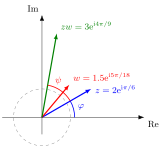
In the figure has length and angle , and has length and angle . The product has length and angle : the arc is the angle of , and the arc on top of it is the angle of , added on. In general complex multiplication multiplies the moduli, , and for nonzero and the arguments add modulo . So multiplying by stretches by the factor and rotates by the angle of .
Drag and : the length of is the product of the lengths, and its angle is the sum of the angles.
The two descriptions suit different tasks. The Cartesian formula is the quickest way to compute a product such as ; the polar form shows what multiplication does to the picture and leads to De Moivre's formula for powers. Multiplying by the imaginary unit, which has length and angle , is a quarter turn; multiplying by a real number is a pure stretch.
A common slip is to multiply part by part, as in complex addition: is not . For that rule would give , but .
Key Results
- The multiplicative identity for complex numbers is which is the real number
- Complex multiplication has commutativity, associativity, and distributivity over complex addition.
- In polar form, complex multiplication combines stretching, because , with rotation, because arguments add modulo .
Examples
- .
- .
Prerequisites
Related Concepts
- Complex Addition
- Complex Reciprocal
- Polar Representation of Complex Numbers
- Imaginary Unit
- Distributivity
Sources
- Math II: Linear Algebra · Week 1
Aliases: multiplication of complex numbers, product of complex numbers Symbols: complex numbers, element of, phi, pi, psi, real numbers
Last updated: 20 October 2026 03:02
Complex MultiplicationComplex DivisionDe Moivre's FormulaComplex NumberComplex AdditionComplex ReciprocalPolar Representation of Complex NumbersImaginary UnitDistributivity