Cramer's Rule
Theorem
If is a nonsingular matrix, then the unique solution of is given by , where is obtained from by replacing column with .
Interpretation
Cramer's rule expresses each unknown of a square linear system with a nonsingular coefficient matrix as a quotient of two determinants. The denominator is always ; the numerator is the determinant of with the column of replaced by the right-hand side .
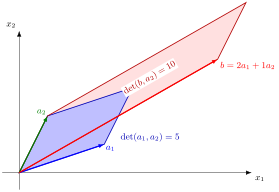
For the illustrated system , and . The blue parallelogram spanned by has area , the red one spanned by has area , so ; similarly . Replacing by multiplies the area by , while the component only shears it.
Each unknown is a ratio of determinants: , where has in column . Make and the rule breaks down.
The same argument works in general. The determinant is linear in each column and is zero when two columns are equal, so replacing column by leaves only the term . The hypothesis cannot be dropped: then the system has no solution or infinitely many, so there is no single value of to give, and elimination is needed to decide which case occurs.
Cramer's rule is convenient for and small systems, or when only one unknown is needed; an system needs determinants, while Gauss-Jordan elimination needs one reduction. The rule is the formula written out with the adjugate matrix.
A common slip is to replace a row of by . It must be column , the column holding the coefficients of .
Key Results
- Cramer's rule applies only when is nonsingular.
- It gives an explicit formula for the unique solution of .
Examples
- For a nonsingular system, and .
- If , Cramer's rule cannot be used.
Prerequisites
Related Concepts
Sources
- Math II: Linear Algebra · Week 4
Aliases: Cramer rule Keywords: determinant formula for linear systems
Last updated: 20 October 2026 03:02
Cramer's RuleDeterminantSystem of Linear EquationsAdjugate MatrixSolution SetInverse and Singular Matrices