Triangular Matrix
Definition
An matrix is upper triangular if every entry below the main diagonal is zero: for .
It is lower triangular if every entry above the main diagonal is zero: for .
Interpretation
The main diagonal consists of entries with equal row and column indices. Comparing and locates each entry below or above it and specifies which entries must vanish.
Triangular matrices are almost diagonal. They are useful because many computations, such as determinants and solving systems, become simpler.
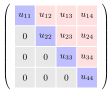
The entries below the main diagonal are zero, and . Its eigenvalues are the diagonal entries; if they are nonzero, can be solved by back substitution. A lower triangular matrix instead has zeros above its main diagonal.
Key Results
- Every diagonal matrix is both upper and lower triangular.
- The determinant of a triangular matrix is the product of its main diagonal entries.
- A matrix that is both upper triangular and lower triangular is diagonal.
Examples
- is upper triangular.
- is lower triangular.
Prerequisites
Related Concepts
Sources
- Math II: Linear Algebra · Week 5
Aliases: upper triangular, lower triangular Keywords: upper triangular matrix, lower triangular matrix
Last updated: 20 October 2026 03:02
Triangular MatrixLU DecompositionMatrixMatrix DiagonalsDiagonal MatrixDeterminantEigenvalue and Eigenvector