Invariant Subspace
Definition
Let be a linear operator. A subspace is an invariant subspace under if for every .
Interpretation
An invariant subspace is a part of the vector space that the operator never sends outside itself.
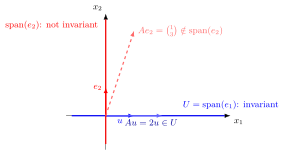
The figure uses . The horizontal axis is invariant: a vector on it is sent to , which stays on the axis. The vertical axis is not, since leaves it. The in the lower left entry of is what keeps invariant: it says that has no -component.
A line with is invariant if and only if for some , that is, if and only if is an eigenvector. So the one-dimensional invariant subspaces are exactly the eigenvector lines. Besides the horizontal axis, the figure's matrix has the invariant line through , which it sends to . The kernel is invariant because its vectors go to , and the range because every lies in it.
If the first vectors of a basis span an invariant subspace, the first columns of the matrix in that basis have zeros below row , a block upper triangular shape; above is the case . The span of a Jordan chain is invariant as well, which is why the Jordan normal form splits into separate blocks.
Invariant does not mean unchanged: must stay in but may differ from , as does in the figure.
Key Results
- , , , and are basic invariant subspaces.
- If , then is invariant under .
Examples
- For a diagonal matrix, each coordinate axis is invariant.
- The kernel of any linear operator is invariant under that operator.
Prerequisites
Related Concepts
Sources
- Math II: Linear Algebra · Week 6
Aliases: stable subspace Symbols: element of, lambda, subset
Last updated: 20 October 2026 03:02
Invariant SubspaceSubspaceLinear OperatorEigenvalue and EigenvectorJordan Normal FormGeneralized Eigenvector