Cauchy–Schwarz Inequality for Random Variables
Theorem
For random variables and with and (which also makes integrable),
If either second moment is zero, equality holds trivially.
For centred variables, the second moments are their Variance and Standard Deviation quantities: applying the inequality to and gives .
Interpretation
The average product of two variables with finite second moments can never exceed the product of their root-mean-square sizes and . Applied to centred variables, this bounds covariance and keeps correlation between and .
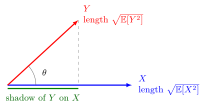
The figure draws and as arrows of lengths and , with in the role of the inner product. When , the shadow of on has length , and a shadow is never longer than the arrow itself; squaring gives the inequality. The inequality is also what makes a number in , so that is a genuine angle. Equality means the arrows lie on one line, the Key Result almost surely.
never exceeds . Remove the noise in the linear model to reach equality.
This is the Cauchy–Schwarz inequality from Math II in a new setting. If the sample space has equally likely outcomes, is times the dot product of the vectors of values of and , so the two statements coincide. Taking and gives , and when equality holds only for an exact linear relation almost surely.
A tempting but false version is . For it would say , which fails for every with positive variance; the correct bound uses second moments on the right.
Key Results
- .
- If both second moments are positive, equality holds exactly when almost surely for some real .
Examples
- If and , then .
- Taking gives ; for a fair die this is .
Prerequisites
Related Concepts
Sources
- Nicky van Foreest · Probability Distributions · Week 7
Symbols: infinity, sigma, square root, theta
Last updated: 20 October 2026 03:02
Cauchy–Schwarz Inequality for Random VariablesVariance and Standard DeviationCovarianceCorrelationCauchy-Schwarz Inequality