Inequality
Definition
An inequality is a relation which makes a non-equal comparison between two real numbers. There are several different notations used to represent different kinds of inequalities:
- We say is less than if is a negative number, denoted by
- We say is greater than if is a positive number, denoted by
- We say is less than or equal to if is a negative number or zero, denoted by
- We say is greater than or equal to if is a positive number or zero, denoted by
Interpretation
Inequalities describe the order of the real numbers: means that lies to the left of on the number line. The definition reduces every comparison to the sign of one number, the difference .
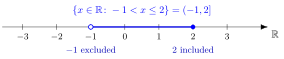
The figure shows the numbers that satisfy both and , written . The open circle at marks a strict inequality, whose boundary point is excluded; the filled dot at marks a non-strict one, whose boundary point is included: is true, while is false.
The sign of explains the rules in the Key Results. Adding to both sides leaves the difference unchanged, , while multiplying by turns it into , whose sign flips when . A common slip is to multiply by a quantity of unknown sign, such as in ; the cases and must be treated separately.
Key Results
- Inequalities define ordering on the real numbers.
- Inequalities are preserved under addition.
- Multiplication by negative numbers reverses inequality direction.
Examples
- If then
- If and then
Related Concepts
Prerequisites
Sources
- Math I: Calculus · Lecture 2
Last updated: 20 October 2026 03:02
InequalityBounded SequenceCauchy SequenceIntervalLower BoundMaximum of a SetMinimum of a SetMonotone SequenceSqueeze Theorem for SequencesUpper BoundMonotonicity of ExpectationBinding and Nonbinding ConstraintsComplementary SlacknessKuhn-Tucker LagrangianChebyshev InequalityGeneralized Markov InequalityReal NumberAbsolute ValueTrichotomy of Real Numbers