Difference Set
Definition
Given two sets and we define the difference set or to be the set with any elements of removed. In other words, we have
Interpretation
The difference keeps the elements of and removes those that also lie in . The set acts only as a filter: its elements outside play no role, and need not be a subset of .
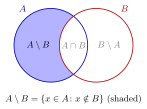
The shaded crescent is , the part of disc outside disc . The lens is removed, and the right-hand crescent is never part of the result. The two crescents are different sets in general, which is the asymmetry in the Key Results, and if and only if . Inside a fixed universal set, with the complement of : "in and not in ".
A common slip is to count elements as . For finite sets the correct count is : with and it is , not . The two agree only when .
Key Results
- Set difference is not commutative: in general (for example but ).
- The difference of a set with itself is empty.
Examples
- If and then
Prerequisites
Related Concepts
Sources
- Math I: Calculus · Lecture 1
Aliases: set difference, difference of sets, relative complement, set minus, set-theoretic difference Symbols: element of, intersection, subset
Last updated: 20 October 2026 03:02
Difference SetComplementSetIntersection of SetsUnion of SetsDisjoint SetsSubtraction and Difference