Convexity and Concavity
Definition
Let be an interval and let be a function. The function is convex on if, for all and every
and concave on if the inequality is reversed. If always gives a strict inequality, we say that is strictly convex or strictly concave.
The point lies between and which is why the domain has to be an interval.
Interpretation
Convexity compares a function with its chords: is convex when the chord between any two points of its graph lies on or above the graph, and concave when it lies on or below it. A convex graph bends upwards, a concave one downwards.
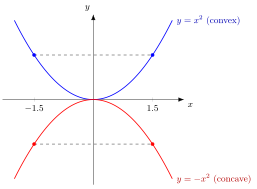
The dashed chords join the points of each graph at and . For the chord lies at height , while the graph dips to in the middle, so is convex. For everything is reflected: the chord lies below the graph, and is concave.
Move , and and compare with the chord value . For the answer depends on where the chord sits.
In the definition, the point runs from to as runs from to , and is the height of the chord above that point, with the same weights. So the inequality says: the value at a weighted average of two inputs is at most the same weighted average of the two values. For differentiable functions this is equivalent to being increasing, and for twice differentiable functions to , as the Key Results state; but convexity itself needs no derivatives, as shows.
Convexity makes optimization simple. A convex differentiable function lies above each of its tangent lines, so on an interval every stationary point of it is a global minimum. Some books say "concave up" for convex and "concave down" for concave; the meaning is the same. The averaging inequality returns in Probability Distributions as Jensen's inequality, and Math IV extends the definition to functions of several variables.
Key Results
- Tangent/secant line test. For a convex graph, secants lie above the curve and tangents lie below it; for a concave graph both comparisons reverse.
- A differentiable function is (strictly) convex on exactly when is (strictly) increasing on and (strictly) concave exactly when is (strictly) decreasing.
- is (strictly) convex if and only if is (strictly) concave.
- Necessary condition. If is twice differentiable at and convex on some interval then if it is concave there, then
- Sufficient condition. If on then is strictly convex there; if then strictly concave; and is affine on i.e. of the form if and only if
- Complete criterion. For twice-differentiable is convex on if and only if throughout, and concave if and only if throughout.
- Strict inequalities are sufficient for strictness but not necessary: is strictly convex although
Examples
- The function is strictly convex on since
- The function is strictly concave on
- The function is convex although it is not differentiable at it is not strictly convex.
- The function is strictly convex on and on separately, but not on which is not an interval.
Prerequisites
Related Concepts
Sources
- Math I: Calculus · Lecture 9
Aliases: concave up, concave down Keywords: convex function, concave function Symbols: alpha, element of, epsilon, infinity, real numbers, union
Last updated: 22 October 2026 19:04
Convexity and ConcavityInflection PointJensen InequalityConvex Order and More Dangerous RisksExpected Utility and Risk AversionFunctionIntervalSecond-Order ConditionLocal ExtremumGraph of a FunctionHigher-Order Derivative