Supremum
Definition
Let be nonempty and bounded above. The supremum of is its least upper bound, denoted by
Interpretation
The supremum of a set is its least upper bound: the smallest number that no element of the set exceeds. It describes where a set ends on the right even when no element sits there, that is, even when the set has no maximum.
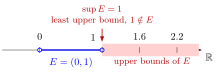
For , every number from onwards is an upper bound, such as the marked and ; together they form the shaded ray . Its left end is the least upper bound, so , although .
Move the candidate : every number at or above is an upper bound, and for every some element of lies within below it, which is what makes it the least one.
Being the least upper bound has two parts: is an upper bound, and no smaller number is one. The second part is usually checked with an : for every some satisfies . For and , the element lies above .
The existence of suprema is the completeness of the real numbers, and several results depend on it: the monotone convergence theorem identifies its limit as a supremum, and the -th root is defined as one. The mirror notion is the infimum.
A common slip is to treat as the largest element of . It is the largest element exactly when it belongs to , and then ; for it does not belong to the set.
Key Results
- A supremum need not belong to the set.
- By the least-upper-bound property (see real number) of every nonempty subset of that is bounded above has a unique supremum.
- In the extended real numbers, one uses the conventions for a nonempty set with no upper bound and neither nor is a real number.
Examples
- The supremum of is
- The supremum of is
Prerequisites
Related Concepts
Sources
- Math I: Calculus · Lecture 3
Aliases: least upper bound, sup Symbols: element of, epsilon, infinity, real numbers, subset
Last updated: 20 October 2026 03:02
SupremumMonotone Convergence Theoremn-th RootLimit Superior and Limit InferiorUniform NormUpper BoundInfimumMaximum of a SetBounded SetBounded FunctionExponentiation and PowerReal Number