Cartesian Coordinate System
Definition
An ordered pair records which entry comes first, so exactly when and For sets and the set of all such pairs with and is the Cartesian product and is abbreviated the coordinate plane.
A Cartesian coordinate system in that plane specifies each point uniquely by a pair of real numbers called coordinates, the signed distances to the point from two fixed perpendicular oriented lines called the coordinate axes. The point where the axes meet is the origin and has coordinates
Interpretation
A Cartesian coordinate system names every point of the plane by an ordered pair of real numbers, and every ordered pair names exactly one point. This turns geometric questions into algebraic ones: curves and other shapes are described by equations in the coordinates, and equations can be drawn as shapes.
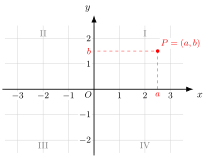
The point is reached by moving units along the -axis and then units parallel to the -axis; the dashed lines drop from to these two coordinates. The axes divide the plane into four quadrants, numbered I to IV anticlockwise from the upper right. Both coordinates are positive in quadrant I and negative in quadrant III; in II the first coordinate is negative, in IV the second. Points on an axis belong to no quadrant.
Because the axes are perpendicular, Pythagoras gives the distance between and as , and an equation describes the set of points whose coordinates satisfy it. For example, is the circle of radius around the origin, and the graph of a function is the set of points .
The same construction with axes gives the Euclidean space of Math II.
Key Results
- Cartesian coordinates specify the point in an -dimensional Euclidean space for any dimension .
Examples
The point lies two units to the right of the vertical axis and three units below the horizontal axis. Swapping its coordinates gives , a different point. If and , then , whereas .
Prerequisites
Related Concepts
Sources
- Math I: Calculus · Lecture 4
Aliases: rectangular coordinate system, Cartesian coordinates, rectangular coordinates Symbols: element of, real numbers, square root
Last updated: 20 October 2026 03:02
Cartesian Coordinate SystemGraph of a FunctionEuclidean NetworkCartesian Representation of Complex NumbersReal Coordinate SpaceSetReal NumberCoordinateOrigin