Extreme Value Theorem
Theorem
Let be real numbers, and let be a continuous function on Then attains its global maximum at and also attains its global minimum at
Interpretation
The extreme value theorem guarantees that a continuous function on a closed and bounded interval attains both a largest and a smallest value. It does not say where they are, only that a search for them cannot come back empty.
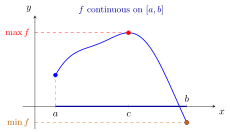
In the figure the maximum is attained at the interior point , the highest point of the graph, and the minimum at the endpoint . Both are values that actually takes, and , not merely bounds that it approaches. The theorem allows either kind of location, so the endpoints always have to be checked.
On a closed interval both extreme values are attained. Switch to the open interval , or to the function with a jump, and watch an extreme value turn into a supremum or infimum that is never reached.
Each hypothesis is needed. On the open interval the function comes arbitrarily close to without reaching it, so it has no maximum; on the unbounded interval the same function is not even bounded above. Without continuity a jump can remove the extreme value: on , the function equal to for and to at has supremum but never takes the value . The hypotheses are sufficient, not necessary: attains its maximum on the open interval , at .
In the language of global extrema, the theorem says that a continuous on has a global maximum and a global minimum; in particular, is bounded there and its supremum is a maximum. Math III extends the theorem from closed bounded intervals to a wider class of sets in the extreme value theorem on compact sets.
Key Results
- The theorem does not apply to open or unbounded intervals.
- The theorem does not apply to functions that are not continuous.
Examples
- The function on attains the largest value and the smallest value
- The function has no maximum on
Prerequisites
Related Concepts
Sources
- Math I: Calculus · Lecture 5
Aliases: EVT, Weierstrass extreme value theorem Symbols: element of, infinity, pi, real numbers
Last updated: 20 October 2026 03:02
Extreme Value TheoremContinuityGlobal ExtremumCompact SetBounded FunctionExtreme Value Theorem on Compact Sets