Infinite Series
Definition
Let be a sequence. For any integer we define the -th partial sum, formed by the finite series of the first terms, of this sequence to be a real number 1. If the sequence converges to as then we say that the infinite series is convergent and converges to We write and say that is the sum of the infinite series. 2. If the sequence diverges, then we say is divergent.
Interpretation
An infinite series adds up infinitely many terms, and the definition gives this a precise meaning: add the first terms, an ordinary finite sum, and ask whether these partial sums settle down as grows. The sum of the series is the limit of the sequence , not the result of adding infinitely many numbers one by one.
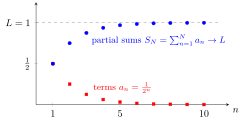
The figure shows the geometric series with terms . The terms (red squares) shrink towards , while the partial sums (blue dots) rise towards the dashed line at . Each blue dot is the previous one plus the next term, , and the series converges to .
Increase : a series converges exactly when its partial sums settle. Compare , whose terms shrink but whose sums do not settle, with , whose terms do not shrink at all.
Two sequences are involved and should be kept apart: the terms and the partial sums . Since , a convergent series has , which is the necessary condition in the Key Results. The converse fails: the terms of the harmonic series tend to , but its partial sums grow past every bound, only slowly.
A common slip is to regroup the terms as if the series were a finite sum. Grouping suggests the sum , and suggests . In fact diverges: its partial sums alternate between and .
The same pattern, a limit of finite approximations, returns later in improper integrals.
Key Results
- A necessary condition for an infinite series to converge is that its terms tend to zero.
- A series may still diverge even if its terms tend to zero.
Examples
- diverges.
- converges.
Prerequisites
Related Concepts
Sources
- Math I: Calculus · Lecture 10
Aliases: infinite sum Symbols: element of, infinity, real numbers, sum
Last updated: 20 October 2026 03:02
Infinite SeriesAlternating SeriesComparison Test for SeriesGeometric SeriesHarmonic SeriesIntegral Test for Convergencep-seriesInfinite Series of FunctionsRatio TestRoot TestFinite SeriesLimit of a SequenceAlternating Series TestAddition and SumSequenceExpectation