One-Sided Limit
Definition
Let be a real-valued function and let
Assume that there exists an such that is defined for every We say that has a right-hand limit at and write
if for every there exists a number with such that
Assume that there exists an such that is defined for every We say that has a left-hand limit at and write
if for every there exists a number with such that
Interpretation
One-sided limits describe the behaviour of a function as the input approaches a point from one direction only: for the right-hand limit only the values at count, for the left-hand limit only those at . As for the limit at a point, the value plays no role.
Only one side of counts. For the jump, works from the right and from the left; switch sides and see each candidate fail on the other side.
Compared with the two-sided definition, the condition is cut in half to or , so a one-sided limit asks for less. If is defined on both sides of , the two-sided limit exists if and only if both one-sided limits exist and are equal, and then all three coincide. This is the standard way to show that a limit does not exist: find two one-sided limits that differ, as for the signum function at .
One-sided limits make limits possible at an endpoint of an interval, where only one side belongs to the domain, and they classify singularities: a jump has two finite but different one-sided limits, and a vertical asymptote needs only one infinite one-sided limit. They also define one-sided continuity.
The notation stands for a limit, not for a value of . In general , and can be three different numbers: for the signum function at they are , and .
One-sided limits return later in one-sided derivatives.
Key Results
- One-sided limits may exist independently of each other. Infinite one-sided limits are defined analogously: means that for every there exists such that the cases with or are analogous (see divergence to infinity).
- Equality of both one-sided limits implies existence of the two-sided limit.
- One-sided limits are essential for defining one-sided continuity and derivatives.
Examples
- The signum function has distinct one-sided limits at the origin.
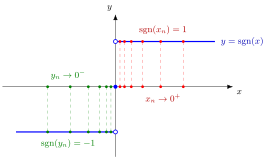
Along the values are , along they are : .
Prerequisites
Related Concepts
Sources
- Math I: Calculus · Lecture 5
Aliases: right-hand limit, left-hand limit, right limit, left limit Symbols: delta, element of, epsilon, infinity, real numbers
Last updated: 20 October 2026 03:02
One-Sided LimitOne-Sided ContinuityOne-Sided DerivativeLimit at a PointSignum FunctionDivergence to InfinityPunctured NeighbourhoodFloor and Ceiling Functions