Reciprocal
Definition
The reciprocal of a nonzero rational number written is the unique rational number satisfying
If with then
The reciprocal of is undefined. The same definition applies to nonzero real numbers.
Interpretation
The reciprocal undoes multiplication by : multiplying by and then by returns every number to where it started, because . It plays the same role for multiplication as the negation plays for addition, and it makes division possible: .
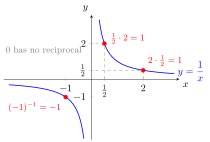
The curve pairs each nonzero with its reciprocal. The points and show that taking the reciprocal twice returns the original number, and shows that a reciprocal has the same sign as . There is no point above , because for every .
A common slip is to treat reciprocals like sums: is not , since gives . In Math II the reciprocal returns as an example of an inverse element.
Key Results
- The reciprocal of a nonzero number is unique.
- for every
- when and are nonzero.
- For positive numbers, taking reciprocals reverses order: if then
- Zero has no reciprocal.
Examples
- The reciprocal of is
- The reciprocal of is
- The reciprocal of is
Prerequisites
Related Concepts
Sources
- Math I: Calculus · Lecture 2
Aliases: multiplicative inverse Symbols: element of, integers
Last updated: 20 October 2026 03:02
ReciprocalDivision and QuotientHarmonic SeriesRational NumberMultiplication and ProductRational FunctionExponentiation and Power