-th Root
Definition
Let be a nonnegative real number, and let be a positive integer. The principal -th root of is
It is the unique nonnegative real number whose -th power is When is odd, the root extends to every real : is the unique real number satisfying and
Interpretation
The -th root undoes the -th power: is the nonnegative number whose -th power is . It extends exponentiation from integer exponents to fractional ones.
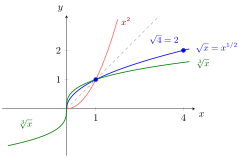
The graph of is the mirror image in the line of the graph of for , because the root swaps input and output. The marked point records , that is , and lies on all three curves. The cube root continues to the left of : every real number, negative or not, has exactly one real cube root.
Change : the -th root undoes , so its graph is the mirror image in . For odd both are defined on all of ; for even only for .
The definition uses a supremum instead of a formula because the existence of a number such as , which is irrational, is exactly what has to be proved. The set contains and is bounded above by , so its supremum exists by the completeness of the real numbers; one then shows that its -th power equals .
On the map is a bijection, and the principal -th root is its inverse. For odd the power is a bijection of all of , which is why odd roots of negative numbers exist and why only even roots restrict the domain to .
A common slip is to write . The equation has the two solutions , but denotes only the nonnegative one. For the same reason , not .
Key Results
- For nonnegative inputs, the principal -th root is defined as the supremum of a bounded set.
- Even roots are real-valued only for nonnegative inputs; odd roots are real-valued on all of
- If is in lowest terms and is odd, the course uses for every real (with when ).
- The principal -th-root function is increasing on
Examples
- and
Prerequisites
Related Concepts
Sources
- Math I: Calculus · Lectures 3–4
Aliases: nth root Symbols: element of, infinity, real numbers, square root
Last updated: 20 October 2026 03:02
n-th RootComplex Absolute ValueRoot TestExponentiation and PowerSupremumMonomial and Power FunctionDomain