Vertical Asymptote
Definition
Let The vertical line is called a vertical asymptote of the curve if at least one of the following holds:
Interpretation
A vertical asymptote describes unbounded behaviour near a finite input value: as approaches from at least one side, tends to or to , and the graph runs along the vertical line .
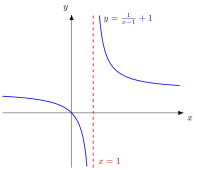
The figure shows . As the term is large and positive, so ; as it is large and negative, so . Either side alone would make the line a vertical asymptote. The same graph approaches the line as , a horizontal asymptote.
Shrink and watch and : for the values run off to on one side and on the other; gives a punctured constant with no vertical asymptote. Change the sign of to swap the sides.
Divergence to infinity at a finite input is the analytic condition behind the vertical line. At least one relevant one-sided limit must be or ; the two sides need not have the same sign. Unboundedness alone is not enough: is unbounded near , but it swings between large positive and large negative values and has no infinite one-sided limit, so the definition does not apply.
For a rational function with no common factor, the vertical asymptotes are the lines at the zeros of . When numerator and denominator share a zero, the point may instead be a removable singularity: has no vertical asymptote at .
Key Results
- Vertical asymptotes arise from divergence to or at finite points.
- One-sided divergence to or is sufficient; unbounded oscillation is not.
- Vertical asymptotes are detected using limits.
Examples
- The function has a vertical asymptote at
- Rational functions often exhibit vertical asymptotes at zeros of the denominator.
Prerequisites
Related Concepts
Sources
- Math I: Calculus · Lecture 5
Symbols: element of, infinity, real numbers
Last updated: 27 October 2026 11:52
Vertical AsymptoteGraph of a FunctionDivergence to InfinityHorizontal AsymptoteSingularityRational Function