Definite Integral
Definition
Let with Suppose is a Riemann integrable function on The following expression
is referred to as a definite integral, which is a real number, not a function of
The symbol is a stylized "S" for "sum", while records the variable and the limiting width:
Here is any point in , the th subinterval of the regular subdivision.
The function is the integrand; and are the lower and upper limits of integration. The letter is a dummy variable, so
Interpretation
The definite integral is a single number that adds up the values of over , each weighted by the length over which it holds: it is the limit of the sums in the Definition. Geometrically it is a net area.
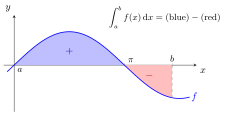
The figure shows from to a point beyond . Up to the graph lies above the axis, and the blue area counts positively; between and it lies below the axis, and the red area counts negatively. The integral is blue minus red, so it is smaller than the total shaded area.
Move and and watch the net area: parts below the axis count negatively, and swapping and flips the sign of .
Each part of the notation has a role. The integrand supplies the heights, and fix the interval, and names the variable of integration and stands for the shrinking widths . The variable is a dummy, so the value does not depend on : is a number, while is a function of its upper limit.
The fundamental theorem of calculus evaluates a definite integral as for an antiderivative , so in practice it is rarely computed from sums.
A common slip is to read the integral as the area itself. Signed area and area differ when changes sign: , although the region between the graph and the axis has area .
Later, improper integrals extend the definite integral to unbounded intervals and integrands.
Key Results
- If is integrable on and then
- The value of a definite integral does not depend on any partition: refining a partition can only decrease upper sums and increase lower sums, and for an integrable function both approach the same number.
- A definite integral measures signed area: regions above the -axis contribute positively and regions below contribute negatively. When it agrees with the ordinary area under the graph.
- By convention, for and hence reversing the limits always changes the sign:
- Varying an endpoint produces the functions and on with and Write never since the latter uses in two different roles.
-
A definite integral does not depend on the name of the integration variable, i.e.,
Examples
Prerequisites
Related Concepts
Sources
- Math I: Calculus · Lecture 11
Symbols: element of, infinity, integral, pi, real numbers, sum
Last updated: 20 October 2026 03:02
Definite IntegralFundamental Theorem of Calculus Part 2Improper IntegralIntegration by PartsAbsolutely Continuous DistributionContinuous Random VariableProbability Density FunctionJoint Probability Density FunctionRiemann IntegralIndefinite IntegralDifferentialFundamental Theorem of Calculus Part 1Riemann SumIntegrandLOTUS