Inverse Trigonometric Functions
Definition
Where this appears in the course
Lecture 7 states that the derivatives of the inverse trigonometric functions are derived in that week's tutorial (Tutorial 4) rather than in the lecture itself. The functions and their derivatives are still part of the course.
The inverse sine function is defined as the inverse of the restriction of the sine function to the interval That is, for each is the unique number such that
The inverse cosine function is defined as the inverse of the restriction of the cosine function to the interval That is, for each is the unique number such that
The inverse tangent function is defined as the inverse of the restriction of the tangent function to the interval That is, for each is the unique number such that
Interpretation
Inverse trigonometric functions recover an angle from the value of its sine, cosine or tangent. The trigonometric functions are periodic, so each value is taken infinitely often; they are therefore first restricted to an interval on which they are injective, and only then inverted. Thus is the one angle in whose sine is .
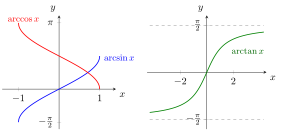
Each graph is the reflection in the line of the restricted sine, cosine or tangent. On , increases from to and decreases from to ; together they satisfy . The function is defined on all of and has horizontal asymptotes at , the mirror images of the vertical asymptotes of at .
Switch the restriction off: on all of the level is hit infinitely often. Restricted to the standard interval, each function is a bijection and , and are its mirror images.
The restriction fixes which angle is returned. So for every , but only for ; for example, . The notation means , not .
The derivatives follow from the inverse function theorem. For with , the angle lies in , where , so . In the same way . At the sine has derivative , and has a vertical tangent there. Math II returns to the arctangent in the 2-argument arctangent, which recovers angles in all four quadrants.
Key Results
- Domain restrictions are essential for defining inverses.
- Inverse trigonometric functions are continuous on their domains.
Examples
Prerequisites
Related Concepts
Sources
- Math I: Calculus · Tutorial 4
Aliases: inverse trig functions, arcus functions, cyclometric functions Keywords: arcsine, arccosine, arctangent Symbols: element of, pi, real numbers, square root
Last updated: 20 October 2026 03:02
Inverse Trigonometric Functions2-Argument ArctangentTrigonometric FunctionsBijection and Inverse FunctionInverse Function TheoremDomain